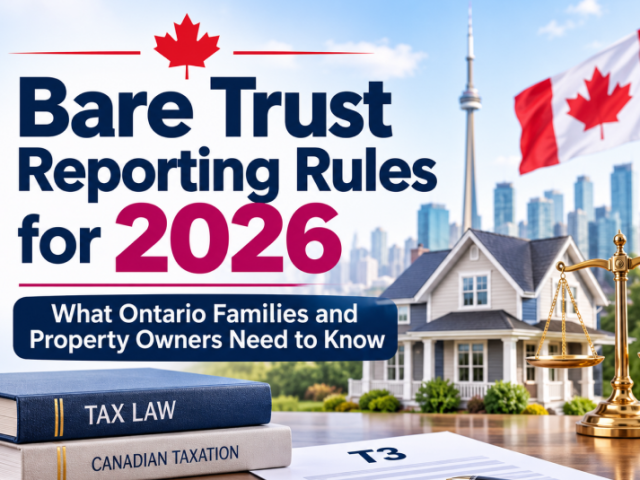


If a parent has included a child in the title of a cabin, a grandparent has set up an “in trust for” account, or your company owns real property under a nominee corporation, you may need to make a new filing for 2026. Bill C-15 has been granted royal assent on March 26, 2026, and it reintroduces certain bare trusts in the T3 reporting for tax years ending after December 30, 2026. The first filings will be due on March 31, 2027. Ordinary family situations are usually exempt. There are some exceptions.
What Changed With Bill C-15
The initial legislation applied to bare trusts from 2023 onwards, but they were not workable. The CRA exempted them from filing for 2023, 2024 and 2025 unless it issued a direct request. Bill C-15 then repealed the initial bare trust rule retroactively and introduced a more restrictive one. Thus, no filing obligations applied to 2024 and 2025, and the new obligations start applying to the 2026 taxation year.
This means that for a calendar year arrangement, a T3 return and Schedule 15 must be filed by March 31, 2027, even if the arrangement did not earn anything during the year. Schedule 15 will require the name, address, date of birth, tax residence and tax identification number of all trustees, beneficiaries and settlers, as well as any individual who influences the trustee’s decisions.
What constitutes a bare trust?
A bare trust arises where one person holds legal title to property solely as a nominee for another. They have no discretion in the matter – they merely follow directions from the owner and must give up the property on demand. Often, there is not even a written instrument. It appears only in the facts of the situation.
This applies to many more common situations than most people realize:
- An adult child puts on the title of their parent’s house or cottage, usually to save probate taxes (Estate Administration Tax in Ontario).
- A parent puts on the title of their child’s property so that they can get a mortgage.
- An “in trust for” bank account opened by a parent or grandparent for a minor.
- A joint bank account opened between an adult child and parent only to pay bills.
- A nominee corporation owning land for its owners or joint venture partners.
- Farmland or a car registered in a personal name, but actually owned by a family corporation.
Which of the arrangements require filings
The reportable group usually includes commercial structures more than familial ones. A nominee corporation that holds land as the owner of only one person or as a joint venture will need to make reports. So will titleholders holding property for a development corporation if this titleholder isn’t a partner. If an adult child of a parent holds sole title to the rental apartment, it will be reportable because rental property can’t be used as a main property for any person. If some farmland is registered in the name of a certain individual who is actually its owner through a farm corporation, such land will be reportable too.
It shows how this very family can be placed on different sides of the line at the same time. Let’s imagine that the mother includes the name of her daughter in the title of the family cottage. Both individuals in this case are legal owners of this property; they are related individuals, and usually, it’s possible to include such a cottage as a main residential property. That’s why the situation here may not be reportable. It depends on the facts of each case.
However, two family situations fall into this gray area. Joint bank accounts established for convenience purposes and “in trust for” bank accounts must satisfy the following dollar tests, as well as determine whether the bank account is indeed a bare trust or an informal trust. This must be answered first and foremost.
Important exemptions to know
Some exemptions help keep the majority of families from filing.
- Temporary trusts. Any trust that has been in existence for three months or less is exempt, covering the majority of cases of closing and escrow.
- The $50,000 test. This applies to any trust that holds assets worth $50,000 or less in the entire year.
- The family trust exemption. Any trust that has all its trustees and beneficiaries as individuals who are related to each other, and that only owns low-risk assets, is not subject to the requirement until it reaches $250,000 worth of such assets in a year.
- Mirror ownership. If the individuals on title are precisely those individuals who beneficially own the property, such as with a typical joint spousal account, then there is no filing required.
- Principal Residence Arrangements. Individuals who are related and own real property that may serve as the principal residence of one of the legal owners are exempt. This includes an individual on title for their child’s mortgage and a parent who remains on title and occupies the property.
- Other exceptions. Real property owned by spouses that may serve as a principal residence, partnership property for which a T5013 has been filed, and court-ordered arrangements are also exempt.
The dollar tests apply through the year, not at year-end. An account that starts the year at $45,000 and ends the year at $60,000 does not meet the $50,000 exemption, despite being below the line to start.
Penalties for failing to file by the deadline
CRA relief from 2023 to 2025 does not extend into 2026. Normally, the penalty for late filing is $25 a day, with a minimum penalty of $100 and a maximum of $2,500 per return. This applies whether there’s any tax owing or not, as filing a bare trust return is merely informational in nature.
Should there be willful neglect of the obligation to file the return, or gross negligence, an additional penalty kicks in. This penalty equals the greater of $2,500 or 5% of the highest total fair market value of the trust’s assets in the year, meaning it can mount up fast on a vacation cottage or income-producing property.
What to do now
Time is of the essence. It is only two months before the end of 2026, the year during which the new rules on dollar tests apply. The first return will be due approximately five months from now. Some actions should be taken right away this week.
- Take an inventory. Compile a list of all titles to real property, joint accounts, “in trust for” accounts and nominees. Information from the old searches of title and agreements will serve as a basis.
- Determine what the legal nature of the arrangements is. Whether something is a bare trust is not just a matter of law but a factual issue. When there are no documents in place, it may be wise to draft some to indicate the reason for no filing.
- Maintain valuations throughout the year. For everything that approaches $50,000 or $250,000, maintain balances monthly.
- Obtain Schedule 15 information as early as possible. It will take months to obtain a trust account number and obtain identification information from all parties, particularly when there are multiple owners or non-residents involved.
- Consider whether arrangements are still necessary. An unused nominee corporation from an old project, or an unwanted probate-planning arrangement, may be one that is best dissolved. Note that dissolving a bare trust prior to December 31, 2026 does not necessarily eliminate the need to file in 2026, but can avoid filing in subsequent years.
How Beta Taxes Can Help
Beta Taxes is a licensed CPA firm in Ontario that relies on an experienced network of licensed CPAs from across Canada. As a firm from Oakville, we assist families, executors, and property owners within the GTA area to determine which transactions require filing a T3 or Schedule 15. Since the determination process is based on how the title and ownership are written, we collaborate with your lawyer when necessary. [Book a consultation] while you still have time to act rather than react.