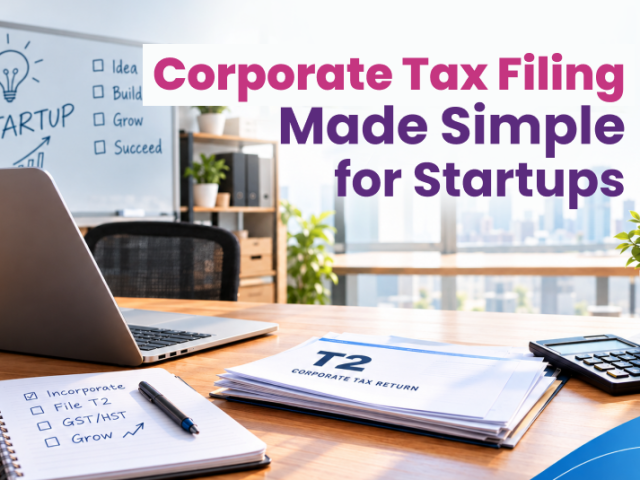


Once you register your company, your business ceases to be you. Your business will become its own taxpayer with an annual tax return to complete, government accounts to deal with, and deadlines that do not care if you have made a single cent. This is how startup corporate tax filing works in Canada for 2026.
What changes when you incorporate
Before incorporation, any profit your business made went onto your personal T1. From now on, the corporation will be filing a T2 for each year that it exists, maintaining its own books and paying its taxes as a separate entity from you, using its own CRA business number. You will be on both sides: either a shareholder or an employee of the corporation, and a taxpayer with a T1 that reflects only what the corporation has paid you.
This comes with tangible benefits. A CCPC that qualifies for the small business deduction pays 9% of federal tax on its first $500,000 of income generated by active business operations, not 15% as would normally be expected, plus Ontario small business rate. In addition, you get limited liability and access to refundable SR&ED credits.
Pick your first year-end strategically
Your fiscal year-end does not need to fall on December 31. You can pick your year-end when filing your first T2 return with that date, but you can’t use a year-end that is over 53 weeks from the incorporation. Any changes will need CRA approval and thus require consideration.
Quiet season year-end makes accounting work much simpler. Year-end falling in December makes your T4S, HST period, and corporate year align, which helps if you plan to start payroll immediately. Since March and April are the most hectic months for accounting professionals, choosing some other date usually results in faster processing.
Planning tip: January and February year-end allow the company to claim the bonus accrued during the year-end as a deduction as long as it was paid within 180 days, while your personal tax is in the following calendar year.
The T2: two deadlines, not one
All resident corporations file a T2 annually, regardless of activity level. Non-active companies file their nil returns. Forget it, and before you know it the delinquent tax years will accumulate – until you decide to raise money, or sell or liquidate your company.
The T2 is generally due six months after year-end. The tax payable is due sooner – two months after year-end, or three for the vast majority of small CCPCs claiming the small business deduction. Interest accrues since that tax payment date whether you’ve filed the T2 or not, along with the late filing penalty at 5% of the unpaid tax and 1% per month late, up to a maximum of 12 months late. You can file your T2 as soon as you have the books, but pay an installment on time if owing tax. T2S must be e-filed too.
Due Date: A December 31, 2026 year-end means the tax payable deadline is February 28, 2027 (March 31 for most small CCPCs), while the T2 itself is due June 30, 2027.
Your tax return is only as good as your books
T2 is prepared using your financial statements. Your accountant matches the income statement and balance sheet to the GIFI codes of CRA. The schedules transform accounting profit into taxable income. It’s not the forms that will delay a first tax filing. It’s a bank account opened in the fourth month, the cost of incorporation that wasn’t recorded, and revenues from your e-transfer history only. These should be sorted out in the first week:
| Account | What it does |
| Business number (BN) | Your corporation’s CRA ID, usually issued at incorporation |
| RC account | Corporate income tax, the account your T2 files under |
| RP account | Payroll remittances, opened before the first pay run |
| RT account | GST/HST collection and input tax credits |
| My Business Account | Online access to all of the above, plus CRA letters |
Set up a separate bank account for your corporation and a corporate card from the very first day, and give your accountant representation status so that they may view balances and mail from the CRA.
Losses, Startup Costs and SR&ED
Startups generally experience losses, and this is allowed by the tax system. Loss is considered a non-capital loss that can be carried back three years and forward 20 years against future profits, so year one loss is a deduction that you are claiming, provided it is reported in the books. Expenses incurred personally before opening the bank account are also included in the books and are shown as amounts owed to you.
When developing a product, consider SR&ED. A CCPC that carries out eligible research and development activities will receive investment tax credits that are refundable, meaning money even in years where there is no tax to offset. Credits exist in Ontario too. The claims rely on records that are kept at the time, including timesheets per project and the technical problem involved, among others.
Paying yourself in year one
You have three choices. The salary route requires an RP account, regular payments, and a T4 by the end of February, but it creates RRSP room and CPP credits. Dividends require a T5 and less administration, but they require retained earnings and create no RRSP room. Alternatively, you take little or no money while the company spends its money, and this works for tax reasons with one exception.
Costly Mistake: Any money taken from the company that is not salary, a dividend, or a repayment of expenses is a shareholder loan. If it is not paid back within a year of the end of the corporation’s tax year during which you took it, it becomes part of your income. Living on the corporate money “until payroll gets figured out” is how entrepreneurs get into this situation.
GST/HST: Registering Early Than Required?
Registration becomes mandatory when your sales that attract GST/HST exceed $30,000 for four consecutive fiscal quarters. However, that is not always wise. In case you sell to other businesses, voluntary registration enables you to deduct input tax credits against your purchases of software, machinery, advertising, and professional fees regardless of any sales and get your business clients refunded for the HST paid. In case you mainly deal with consumers, you do not want to add 13% HST to your prices; therefore, it makes more sense to wait. Either way, you have already lost your input tax credits and must file nil returns.
Where start-ups fail in their first year
There are five common mistakes that keep recurring: unfilled nil returns; personal and business funds not kept separate; made-up salary for founders; T4 or T5 forms not sent out in February; and a payroll account not set up before the first cheque gets cut. Year-two installments tend to trip folks up. They do not occur in the first year of a new corporation, but after that time they do apply as long as there is more than $3,000 of tax payable.
Do It Yourself software, or a CPA?
Dormant companies and their comfortable founders can file a nil return using certified software. But with income, any loss to write off, payments to yourself, GST/HST, and R&D claims, the return becomes a series of decisions that software can execute but never actually make. We are a licensed accounting firm based out of Oakville, Ontario, with a team of licensed Canadian CPAs who will deal with your filing needs, whether you are a startup founder within the GTA.
| 6 months | to file the T2 after year-end |
| 20 years | non-capital loss carry-forward |
| 53 weeks | longest possible first fiscal year |
| $30,000 | HST small supplier threshold over four quarters |